Skip to Content

Zebrafish observation using the Z stacking function

Download the Application Note in Text-Friendly (.MD) Format

Application Note: Zebrafish observation using the Z stacking function using Celloger® Mini Plus

This Application Note demonstrates fluorescence Z-stacking and Z-projection imaging of GFP-expressing transgenic zebrafish larvae using the Celloger® Mini Plus to enable clear three-dimensional visualization. Zebrafish are a widely used vertebrate model in developmental biology, neuroscience, and disease research, yet their optically transparent but structurally complex anatomy makes it challenging to capture all relevant features within a single focal plane.

The problem addressed is the time-consuming and fragmented nature of conventional multi-plane microscopy, which requires researchers to interpret numerous images to understand 3D structures. As a solution, Yamato Scientific America highlights how Celloger® integrates automated Z-stacking with intuitive Z-projection analysis software to acquire multi-layer fluorescence images and merge them into a single, information-rich view. By applying maximum and average projection modes with deviation enhancement, both dorsal and ventral anatomical features of zebrafish larvae are visualized simultaneously.

The key advantage is the ability to generate high-quality, consolidated 3D images that improve interpretability while reducing analysis time, supporting efficient live cell analysis, real-time imaging, and broader applications such as spheroids and organoids. Download the full application note to explore the detailed protocol and comprehensive data set.


Zebrafish, along with mice, is a well-known animal model widely used in biological research such as epigenetics1, clinical research2, neuroscience research3 and so on. Mainly, this is because it is easy to manipulate the zebrafish embryos and larvae genetically, and they are easy to observe using an optical microscope since they are small in size and have high optical clarity.

We introduce the Celloger® series' functions for observing zebrafish. Celloger® Mini Plus provides a Z stacking function that automatically generates multi-layer images and the Celloger® analysis software offers a merge function to combine the multi-layered fluorescent images easily. These functions enable researchers to observe three-dimensional (3D) structures in a single image. We observed transgenic zebrafish (larvae) expressing green fluorescent protein (GFP) using these functions, as detailed in steps 1 and 2 below.

Step1. Z-stacking

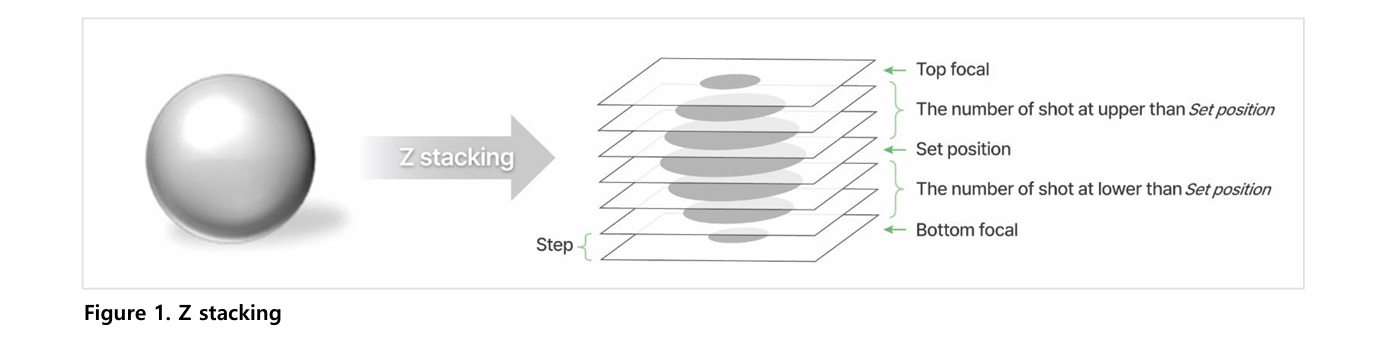
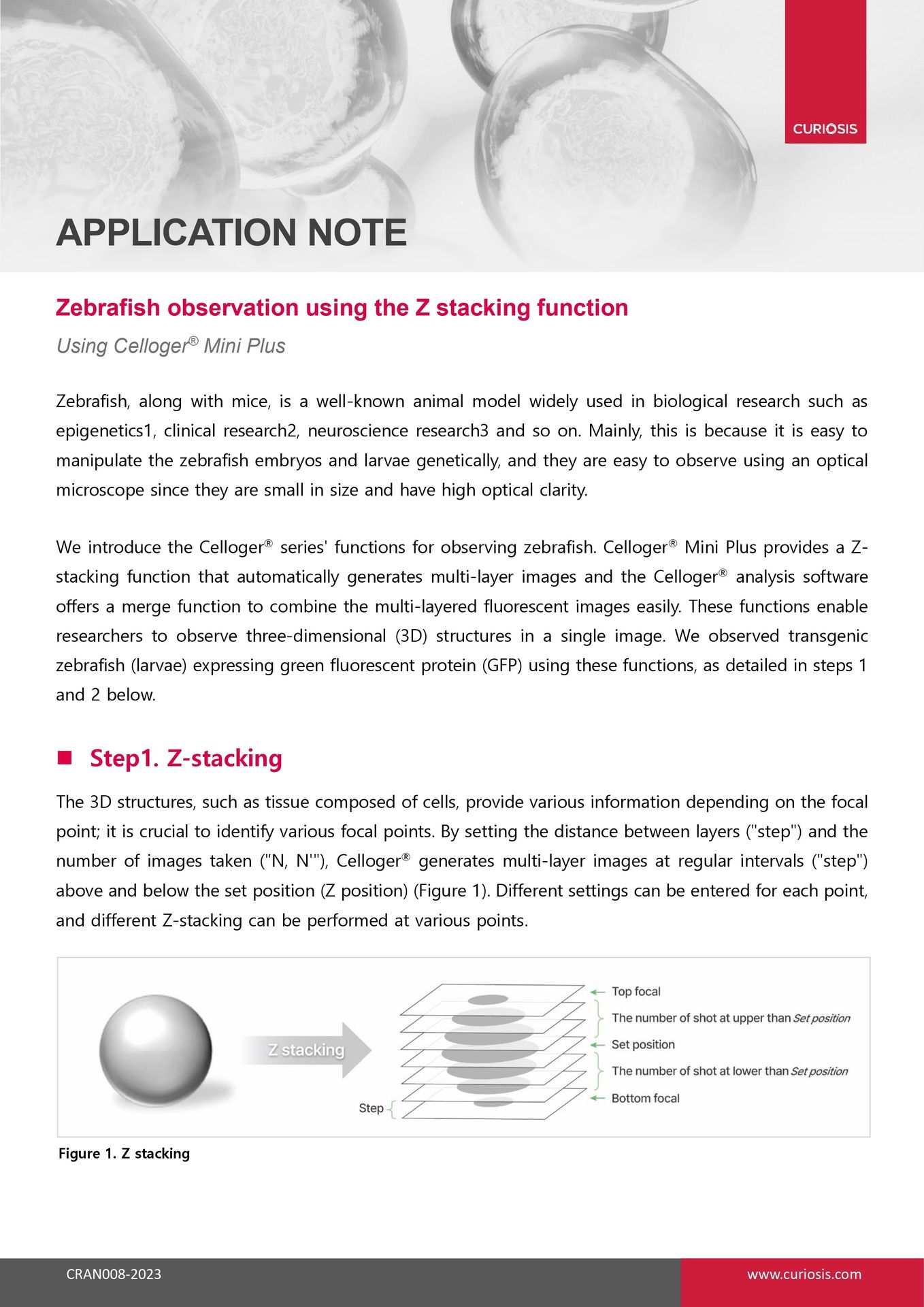
The 3D structures, such as tissue composed of cells, provide various information depending on the focal point; it is crucial to identify various focal points. By setting the distance between layers ("step") and the number of images taken ("N, N'"), Celloger® generates multi-layer images at regular intervals ("step") above and below the set position (Z position) (Figure 1). Different settings can be entered for each point, and different Z-stacking can be performed at various points.

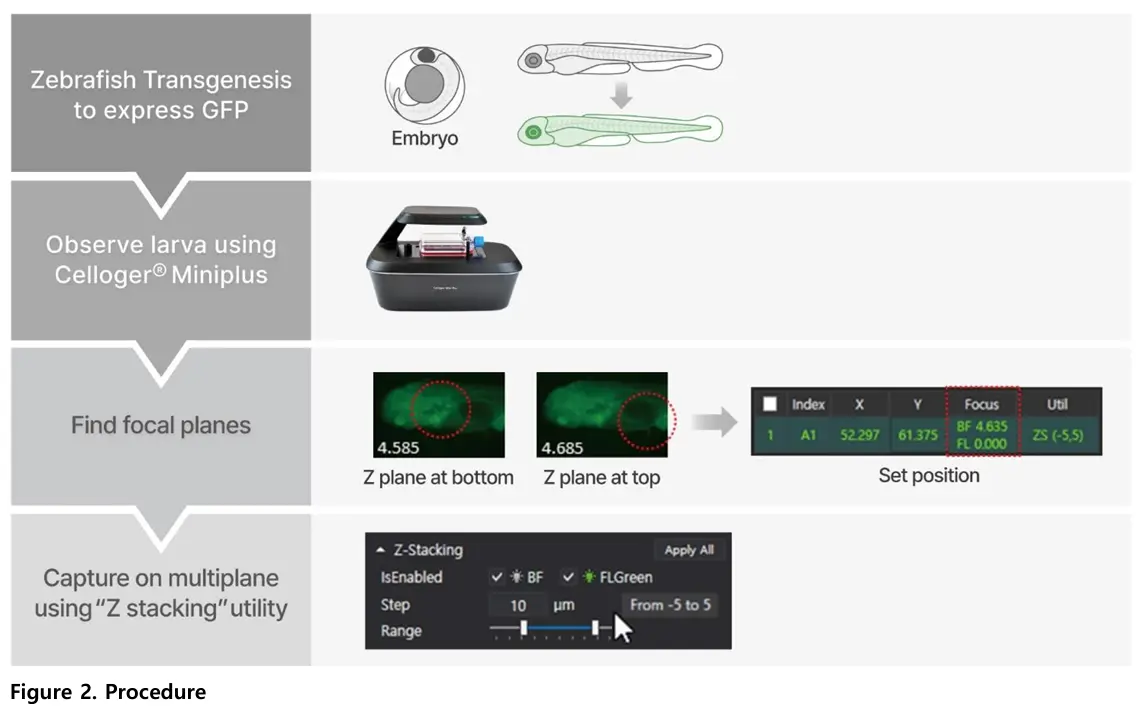
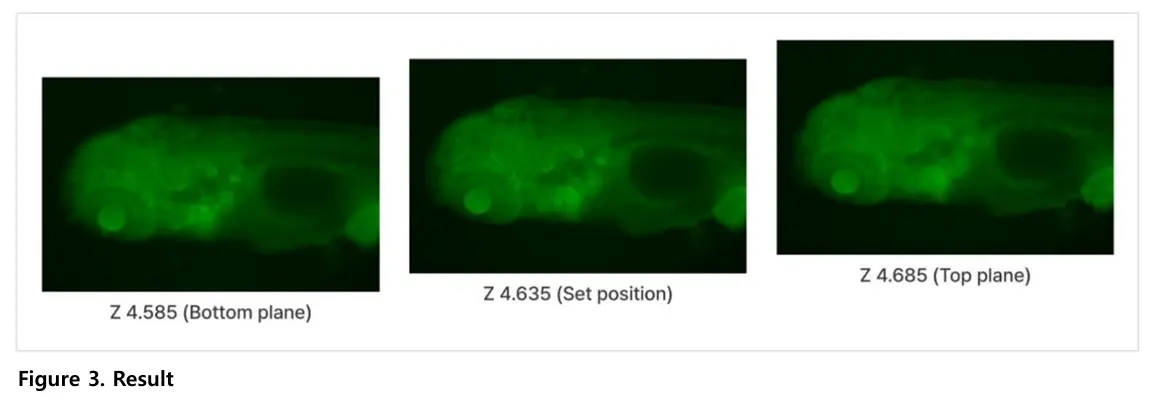
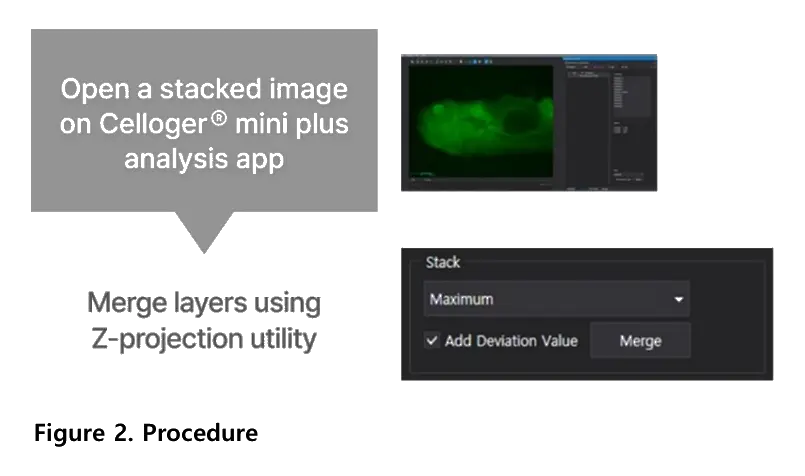
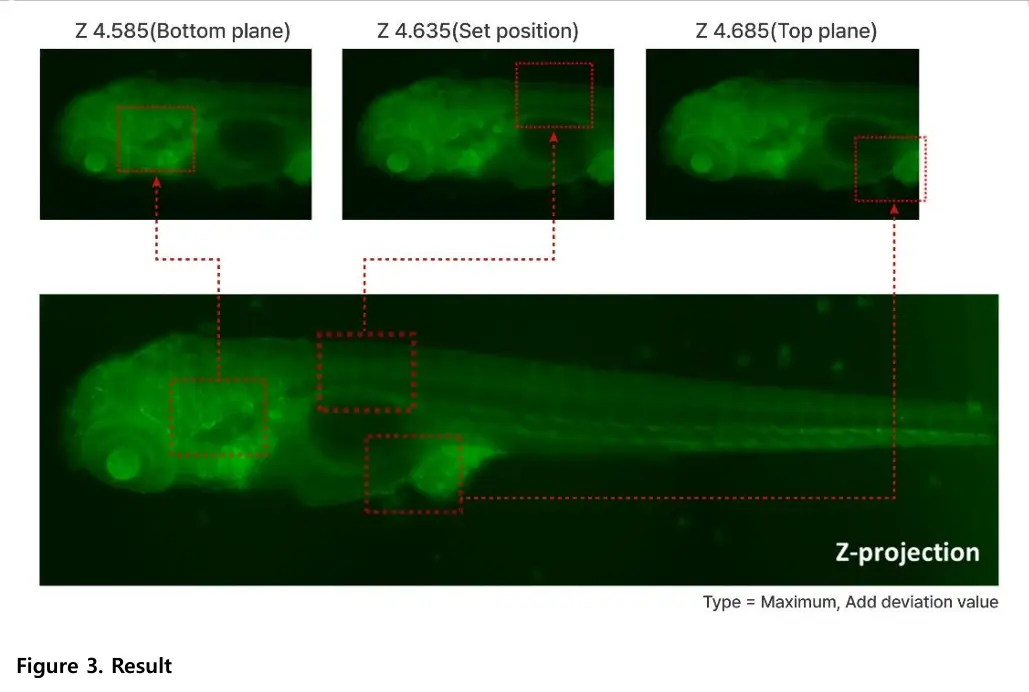
We utilized Celloger® Mini Plus, which enables fluorescence imaging, to create Z-stacked images of the fluorescent transgenic zebrafish. Because the acceptable focus plane varies for each part of the three dimensional larva, we verified the appropriate focal planes by manipulating the motorized Z stage of the process. We identified the top (Z = 4.585) and bottom (Z = 4.685) focal planes among several focal planes and the coordinate (Z = 4.635) was set corresponding to the middle as the scan position. In addition, we set to take five pictures at 10 µm intervals above and below the scan position as the center (Figure 2). Figure 3 shows the pictures captured from the top, middle, and bottom focal planes of the zebrafish. In the side view, the shape of the head was definite in the bottom focal plane, while the ventral part was clearly visible in the top focal plane.


Step2. Z-projection

Multi-layer imaging (Z-stacking) is essential for observing the 3D model. However, interpreting the results of multiple images obtained by multi-layer imaging is laborious and time-consuming. The Z-projection function, which merges several layers into one image, allows one 3D sample to be observed at a glance as one image, thereby increasing the researcher's insight.

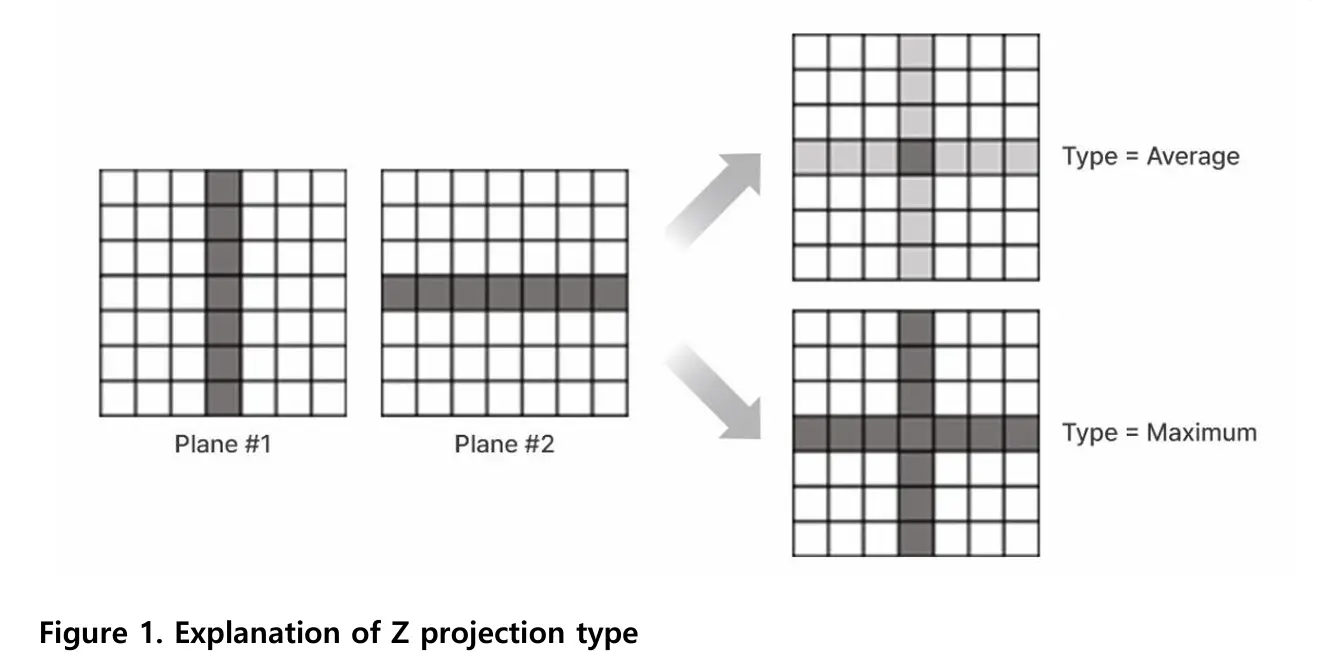
Projection type is a method of integrating several Z coordinates located at each X-Y position. The "maximum" is used to integrate the brightest pixel among several Z coordinate points, while the "average" is used to calculate the average brightness of several Z coordinate points (Figure 1). In addition, "add deviation value," an element that can be reinforced, was added to the Celloger® analysis software to obtain a clearer image.

If the images taken with Z-stacking are opened in the Celloger® analysis software, and the "merge" button on the Z-stack tab is clicked, a Z-projection image can be obtained (Figure 2). The appropriate projection type differs among samples; confirming the result for each type is recommended. Figure 3 shows the result of stitching three images for projection by selecting the "maximum" type and "add deviation value" option. The head structure is clearly expressed on the bottom focal plane, and the unique ventral shape, which can be observed on the top focal plane, is expressed as a single image using the projection function.


Conclusion

We have successfully acquired high-quality fluorescence images of Zebrafish using the Celloger® Mini Plus system. The three-dimensional structure's multiple layers of information were successfully combined and expressed in a single image with clarity. This experiment confirms the feasibility of capturing 3D images using various other sample types, including spheroids and organoids which could expand the range of research scope available to researchers.

Z-stacking is a method that captures multiple images at different focal depths of a 3D sample. It is used to visualize structures that cannot be seen in a single focal plane, such as tissues within zebrafish larvae. This approach ensures detailed observation of complex three-dimensional structures.

The Celloger Mini Plus uses a motorized Z stage to capture images above and below a defined Z position. Users set the step size and number of images, and the system automatically acquires evenly spaced focal planes. This enables consistent and reproducible multi-layer imaging.

Z-projection merges multiple Z-stacked images into a single image. This reduces the need to manually analyze each focal plane and allows researchers to view 3D information at a glance. It makes interpretation faster and less labor-intensive.

Maximum Z-projection selects the brightest pixel from all focal planes at each X-Y position. Average Z-projection calculates the mean brightness across focal planes. The optimal method depends on the sample and imaging goal.  

The add deviation value option enhances contrast in Z-projected images. It reinforces signal differences across focal planes, resulting in clearer visualization of fluorescent structures. This feature is available in the Celloger analysis software.

The study imaged transgenic zebrafish larvae expressing green fluorescent protein (GFP). Fluorescence imaging allowed clear visualization of internal structures across multiple focal planes.

Zebrafish larvae are three-dimensional, and different anatomical features come into focus at different depths. Capturing multiple focal planes ensures that both dorsal and ventral structures are clearly observed. This provides more complete structural information.  

Yes, the application note confirms that the Celloger system can be applied to other 3D samples. These include spheroids and organoids, expanding its usability beyond zebrafish models. This demonstrates the versatility of the Celloger Mini Plus.

Celloger Mini Plus combines Z-stacking with Z-projection through its analysis software. Multi-layer fluorescence images are merged into one clear image that represents the full 3D structure. This allows researchers to assess complex morphology efficiently.

The system enables automated Z-stacking, fluorescence imaging, and easy image merging. It produces high-quality images that clearly represent three-dimensional structures. This improves data clarity while reducing manual effort during analysis.  

Download the full Application Note PDF

to access the complete fluorescence Z-stacking and Z-projection workflow, including imaging settings, projection modes,

 and example datasets demonstrating clear 3D visualization of GFP-expressing zebrafish larvae using the Celloger® Mini Plus.


Real-time imaging and automated quantification of wound closure dynamics