Skip to Content

Analysis of Nocodazole-induced Cytotoxicity

Download the Application Note in Text-Friendly (.MD) Format

Application Note: Analysis of Nocodazole-induced Cytotoxicity using Celloger® Mini Plus

Using real-time live cell imaging, this Application Note evaluates nocodazole-induced cytotoxicity in HeLa cells through quantitative apoptosis monitoring. Traditional endpoint cytotoxicity assays fail to capture dynamic drug responses, creating a gap in understanding dose- and time-dependent cell death mechanisms. To address this, Yamato Scientific America highlights the use of Celloger Mini Plus (Celloger) for continuous, incubator-based live cell analysis combining brightfield confluency and fluorescence-based cell death detection.

HeLa cells were exposed to increasing nocodazole concentrations and stained with a membrane-impermeant fluorescent dye, enabling real-time imaging of apoptosis progression. The Celloger system captured hourly images over 48 hours, while integrated analysis software quantified confluency loss and fluorescence coverage to calculate cell death rates. Results demonstrated clear nocodazole dose-dependent cytotoxicity, with distinct morphological changes, reduced confluency, and increasing apoptotic cell populations over time.

This study shows how real-time imaging, live cell analysis, and quantitative cytotoxicity assays can deliver richer, time-resolved insights compared to endpoint methods. Download the full application note to explore the detailed protocol, real-time imaging workflow, and comprehensive data supporting this approach.


Introduction

Cytotoxicity refers to the degree of damage to cells caused by chemical substances or physical factors. Measuring it through cytotoxicity assay is essential for drug development and biological research. Cells undergo complex signaling pathways that causes various cell death processes such as apoptosis, necrosis, and necroptosis. However, most cytotoxicity assays are measured at the end-point that makes it difficult to study the dynamic response of cells to drugs.

In this application note, we aimed to examine the performance of a cytotoxicity assay using real-time imaging. Cells treated with various concentrations of Nocodazole, the anti-cancer drug, were stained with fluorescent dye during cell death, then monitored with Celloger® Mini Plus. It was observed through time-lapse imaging that apoptosis increased in a Nocodazole dose-dependent manner, and the degree of apoptosis was quantitatively measured and graphed using the Analysis software provided with the Celloger® Mini Plus.


Method

HeLa cells were counted using Facscope B (Curiosis Inc.), an automatic cell counter and seeded at 1 x 10⁴ cells/well in a 48 well plate. After culturing overnight, cells were treated with various concentrations (16.625 nM, 31.25 nM, 62.5 nM, 125 nM, 250 nM) of Nocodazole. At this point, CellTox green dye (Promega, G8742) which binds to DNA of cells with impaired membrane integrity during cell death was added to the sample. Using Celloger® Mini Plus installed inside an incubator, cell images were acquired every 1 hour for 48 hours then the images were analyzed using the Analysis software. The cell death rate (%) was calculated as fluorescence coverage (= dead cell) ÷ bright field confluency (= total cell).


Result

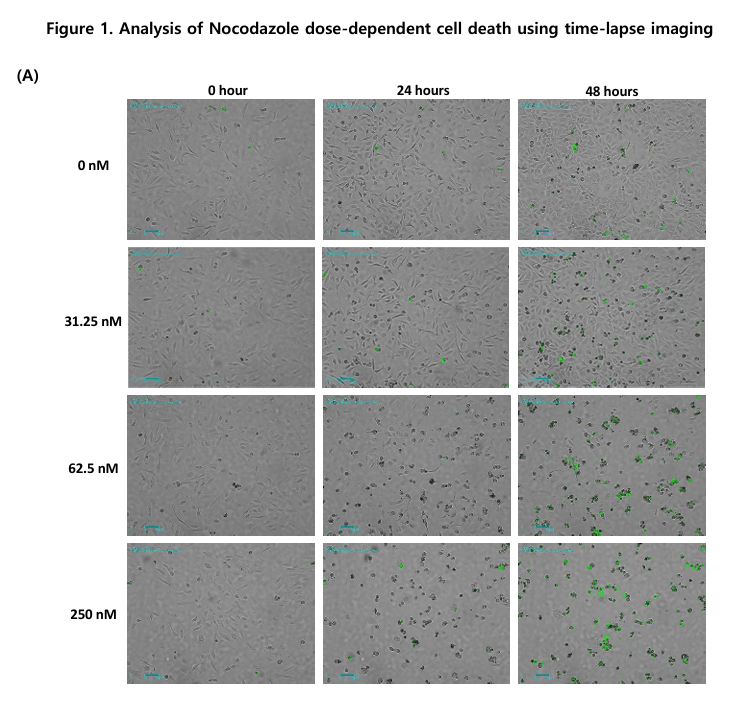
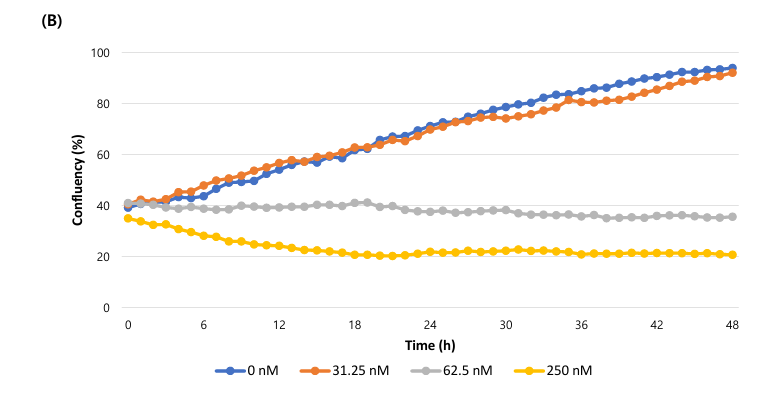
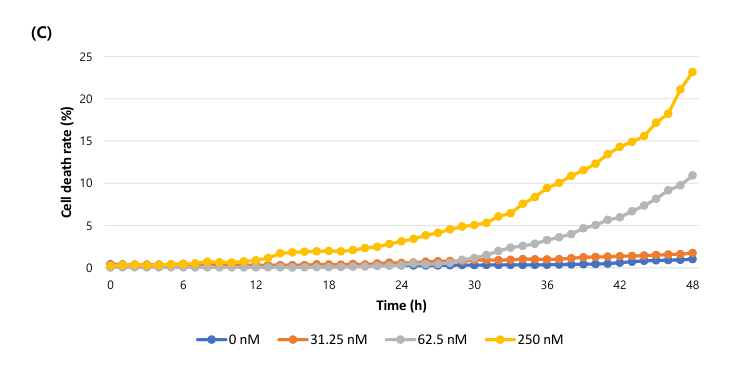
As a result of treating the cells with nocodazole by different concentrations and imaging them over time, the morphology of cells changed in a concentration-dependent manner and the confluency shrinkage was observed in bright field imaging (Figure 1A, B). In addition, fluorescence imaging of dead cells stained by CellTox dye, measuring its coverage and quantifying the cell death showed that the proportion of fluorescent cells increases with apoptosis (Figure 1C).

(A) Merged bright field and fluorescence images for each concentration of Nocodazole. The images are shown at 24-hour intervals, and green fluorescence indicates the dead cells. (Scale bar: 200 um)

(B) The confluency (%) graph of total cell over time.

(C) The graph of cell death rate (%) over time.


Conclusion

Celloger® Mini Plus is a live cell imaging device that can simultaneously perform bright field and fluorescence imaging in an incubator. The system has a fully motorized camera that enables imaging of various positions at a set interval programmed by the user. The confluency graph over time can be acquired by calculating the confluency of captured images using the Analysis software. Furthermore, by measuring the fluorescence coverage, the degree of apoptosis according to the concentration of Nocodazole can be quantified.

Nocodazole-induced cytotoxicity can be measured using real-time live cell imaging combined with a fluorescent cell death dye. In this study, cells were stained with CellTox Green dye and imaged every hour for 48 hours. The dynamic response was monitored using bright field and fluorescence imaging to track apoptosis over time.

The study tested Nocodazole at 16.625 nM, 31.25 nM, 62.5 nM, 125 nM, and 250 nM. These concentrations were applied to HeLa cells after overnight culture. The results showed dose-dependent increases in apoptosis and cell death rate.

The cell death rate (%) is calculated as fluorescence coverage (dead cells) divided by bright field confluency (total cells). Fluorescence coverage represents stained dead cells, while bright field confluency represents overall cell area. This calculation enables quantitative measurement of apoptosis over time.

CellTox Green dye (Promega, G8742) was used to detect dead cells. The dye binds to DNA in cells with impaired membrane integrity during cell death. Fluorescent imaging then allows quantification of apoptotic cells.  

The imaging experiment runs for 48 hours. Images are acquired every 1 hour using the Celloger® Mini Plus installed inside an incubator. This time-lapse approach enables continuous monitoring of cell morphology and apoptosis progression.

The study observed concentration-dependent changes in cell morphology, confluency shrinkage, and increased fluorescence from dead cells. Confluency (%) and cell death rate (%) were graphed over time. Higher Nocodazole concentrations resulted in greater apoptosis.  

HeLa cells were used in this study. Cells were seeded at 1 × 10⁴ cells per well in a 48-well plate and cultured overnight before Nocodazole treatment. This demonstrates the assay’s compatibility with adherent cancer cell lines.

Yes, Celloger® Mini Plus quantifies apoptosis by measuring fluorescence coverage over time. The integrated Analysis software generates confluency and cell death rate graphs. This enables clear comparison of apoptosis across multiple Nocodazole concentrations.  

Real-time cytotoxicity analysis is valuable for drug development and biological research. It allows researchers to study dynamic cell death processes such as apoptosis in response to anti-cancer drugs. The system provides quantitative, time-resolved data that supports dose-response evaluation.

Download the full Application Note PDF

to access the complete nocodazole cytotoxicity protocol, real-time imaging workflow, quantitative apoptosis analysis, 

and detailed time- and dose-dependent data on HeLa cells generated using the Celloger Mini Plus system.

Living Cells or Fragmented DNA?
A practical guide to choosing between CTCs and ctDNA for your cancer research