isoHub
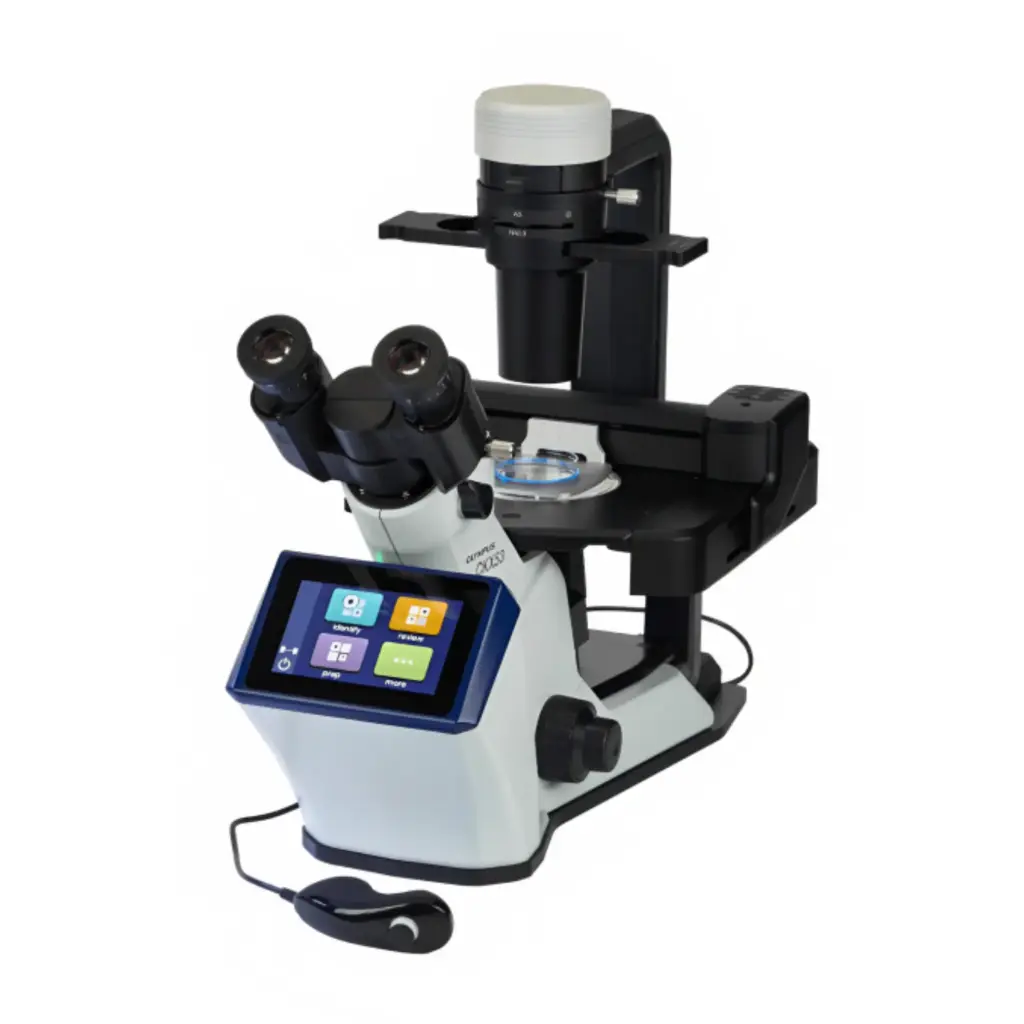
An automated microscope that can be combined with an isoCell or isoPick as part of either the Cloning Platform or scPicking Platform, respectively. Inclusion of the isoHub enhances workflows for both platforms, enabling quick and easy single-cell chamber selection when scanning through GRIDS, and seamless data transfer between devices.
Monoclonality verification you can show an auditor
A cell line is only as defensible as the evidence that it started from one cell. A lab notebook entry saying someone looked is not evidence. The isoHub scans your GRID chambers on a motorized stage, shows each chamber in a single field of view with no optical edge effects, and, with the image capture system, stores a high-resolution photograph of the single cell your clone grew from. Verification becomes a record instead of a recollection.
Automated inverted microscope with motorized stage and hand-held controller for navigating GRID chambers.
Whole-chamber visibility in a single 10x field of view, free of the optical edge effects of conventional plasticware.
Chamber coordinates recorded automatically and synced wirelessly to a paired isoPick or isoCell.
Evident (previously Olympus) optics with brightfield and phase contrast, and 4x, 10x, and 20x objectives as standard.
Optional 16-channel fluorescence module covering 365-770 nm, up to 4 channels at once.
Optional image capture system stores whole-chamber images as documented proof of monoclonality.

How single-cell verification works on the isoHub
After cells are plated into GRID chambers, the isoHub turns reviewing 256 chambers from a manual microscope session into a guided scan...

The motorized stage moves chamber to chamber under hand-held controller navigation, with no manual stage work and no writing down positions.

Because GRIDs are formed with fluids rather than molded plastic walls, each chamber sits fully visible in one 10x field of view. Phase contrast makes single cells simple to identify.

Selecting a chamber records its coordinates automatically, and the selections sync over a 2.4 GHz wireless connection to a paired isoPick or isoCell, ready for picking or clonal culture.
The result is verification of singularity with confidence: you confirm one living cell in the chamber before anything downstream is committed to it.
Documented proof of monoclonality
Regulatory submissions for biopharmaceutical cell lines increasingly expect documented evidence of clonal origin, and a statistical argument from dilution plating is becoming insufficient on its own. The optional image capture system turns the isoHub’s verification step into that evidence...
 A 5.0 MP color camera captures high-resolution, whole-chamber images showing the single cell before picking or outgrowth.
The isoHub Image Capture App stores the images, building a visual record of clonal origin for each line you take forward.
The same system records cell morphology and images of single-cell outgrowth, extending the documentation from day zero through colony formation.
The included workstation comes ready to run: a 14-inch full HD touchscreen, a Dell OptiPlex PC with a 1 TB SSD and 16 GB of RAM, wired and wireless networking, and a wireless keyboard and mouse. For cell line development teams, the deliverable is a folder of time-stamped chamber images, which is the kind of proof of monoclonality an auditor accepts without a follow-up question.
Tracking clonal expansion from a single cell
Verification is the start of a clone’s story, and the isoHub keeps following it. Selected chambers stay on record, so you can return to them and watch clonal expansion as the single cell divides into a colony, in brightfield or fluorescence. Morphology changes, growth rate differences, and failed outgrowth all show up early, before a weak clone consumes weeks of culture time.
For workflows built on reporter lines or labeled cells, the optional fluorescence module makes tracking selective: follow the clones carrying the signal you care about and drop the rest.
Fluorescence screening for cells and colonies
The optional fluorescence module is a CoolLED pE-4000 with 16 LED channels spanning 365-770 nm excitation...
Run up to 4 channels at the same time, with each channel’s intensity adjustable from 0 to 100%.
Simple on/off button operation, with no lamp warm-up or alignment ritual.
Screen cells and colonies by fluorescence during chamber selection, so antigen-positive cells, reporter-expressing clones, or labeled populations are identified before picking.
Paired with an isoPick, fluorescence-identified selections carry straight through to picking with no manual record keeping between the two instruments.
One microscope, two platforms
The isoHub is the imaging half of two connected workflows...
With the isoPick, it forms the scPicking Platform: the isoHub verifies and selects single cells in GRID chambers, and the isoPick picks and deposits them into plates, PCR tubes, or LC-MS vials.
With the isoCell, it forms the Cloning Platform, pairing verification and clone tracking with automated clonal culture.
Beyond GRIDs, the isoHub also images standard cell culture plates, flasks, and 60 mm dishes, so the optics earn their bench space between single-cell runs. A heated bed is available at additional cost for cells that need warmth during longer sessions.
isoHub specifications
Common questions about monoclonality verification
Monoclonality verification is confirming that a cell line originated from a single cell rather than a mixed population. In practice it means observing exactly one cell at the founding step and, increasingly, documenting that observation. The isoHub handles both: whole-chamber visibility confirms the single cell, and the optional image capture system stores the photograph.
The strongest evidence is an image of the founding single cell at day zero, before outgrowth. The isoHub captures high-resolution, whole-chamber images of each verified cell and stores them through the Image Capture App, giving cell line development teams a visual record of clonal origin to include in documentation packages.
Conventional molded plasticware produces optical edge effects: distortion near well walls that hides cells sitting at the edges. GRID chambers are formed with fluids rather than molded walls, so the whole chamber sits flat and visible in a single 10x field of view, and a cell has nowhere to hide.
The isoHub is designed as the imaging half of the scPicking Platform (with the isoPick) or the Cloning Platform (with the isoCell), and that pairing is where the automated coordinate sync pays off. It also images standard cell culture plates, flasks, and 60 mm dishes, so it works as a general automated inverted microscope between single-cell runs.
Yes. Selected chamber coordinates stay on record, so you can return to each clone and follow its expansion in brightfield or fluorescence. The image capture system records outgrowth over time, which surfaces weak or abnormal clones before they consume weeks of culture effort.
An optional CoolLED pE-4000 module adds 16 LED channels spanning 365-770 nm excitation, with up to 4 channels running simultaneously and per-channel intensity control from 0 to 100%. Operation is a button press, with no lamp warm-up.
A 5.0 MP color camera with heatsink, a 14-inch full HD USB-C touchscreen, a Dell OptiPlex PC with a 1 TB SSD, 16 GB of RAM, and an Intel i5 processor, wired and wireless networking, a wireless keyboard and mouse, and the isoHub Image Capture App for capturing and storing chamber images.
Yes. A heated bed is available at additional cost for cells that need temperature control during longer verification or tracking sessions.
