isoPick
An advanced single-cell picking system designed to make precise, gentle, and reproducible cell isolation accessible to every lab. Built on iotaSciences’ patented isoCell microfluidic technology, isoPick streamlines single-cell selection and transfer eliminating manual pipetting, reducing contamination risks, and ensuring cell integrity throughout the workflow.
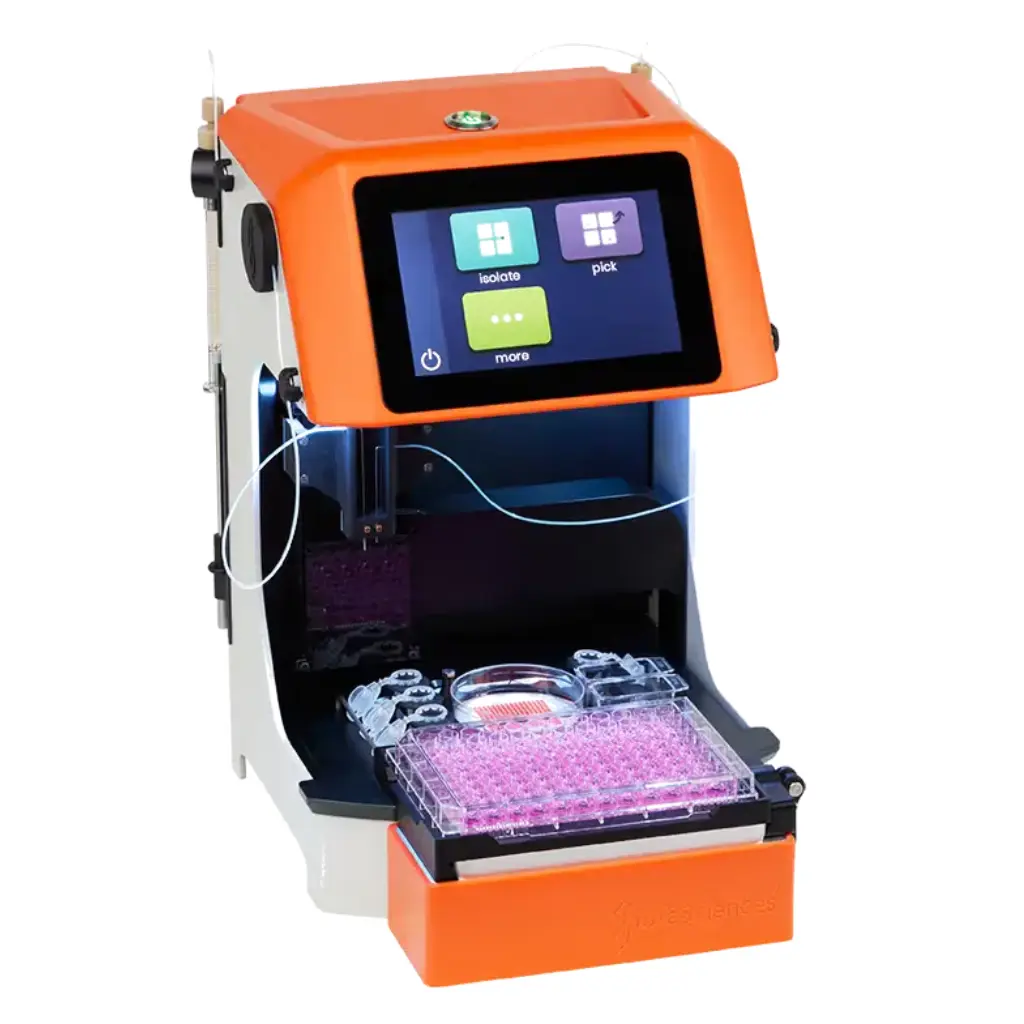
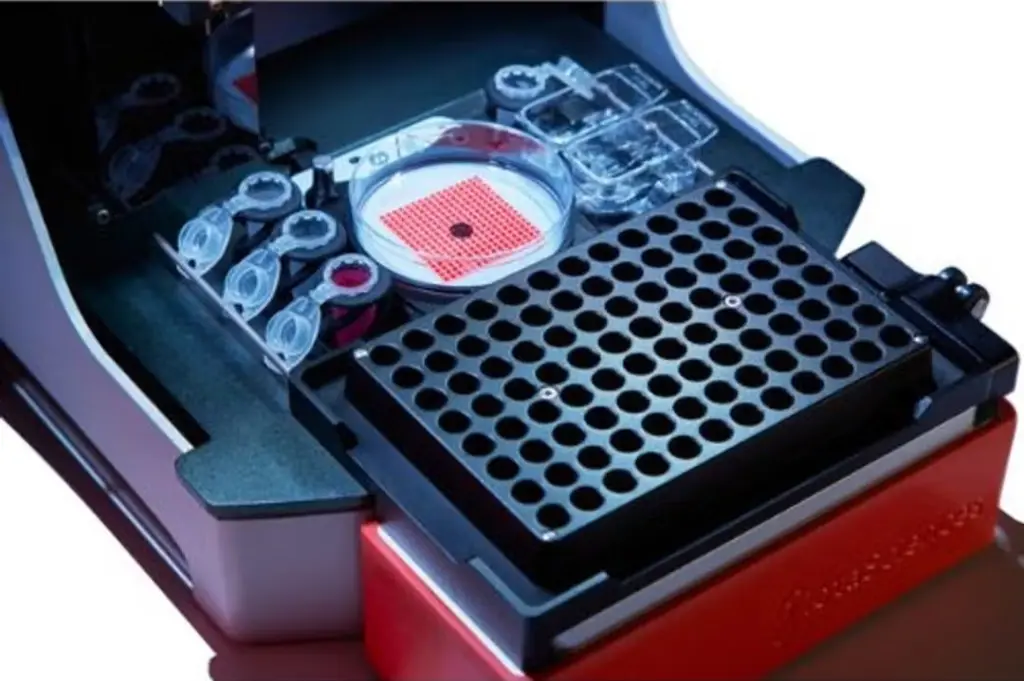
Automated single cell isolation system that shows you the cell before you commit
The isoPick removes the guessing with every single cell application.
It dispenses your cells into 256 tiny chambers, lets you confirm exactly one living cell under any inverted microscope, then picks that verified cell and deposits it where your workflow needs it.
Verify exactly one cell before you pick it, with single-cell assurance of up to 100%.
Gentle handling at under 0.5 psi preserves viability through isolation and transfer.
Deposits into 96-well TC plates, 96-well PCR plates, 8-strip PCR tubes, or LC-MS vials.
Plates cells across 256 GRID chambers in 120 seconds, hands-free.
Fits inside a biosafety cabinet at 210 x 300 x 300 mm and under 5 kg.
Optional cooling blocks, plus isoHub integration for automated chamber scanning, fluorescence, and monoclonality imaging.

How automated single cell picking works
The workflow runs in three steps...

DISPENSE
The isoPick plates your cell suspension across the 256 chambers of a GRID dish in 120 seconds. Based on Poisson distribution, up to 94 chambers per dish hold exactly one cell.

VERIFY
GRID chambers avoid the optical edge effects of conventional plasticware, so every cell sits visible in a single field of view. Confirm single, living cells on any inverted microscope with a 4x or 10x objective.

PICK
The system transfers each verified cell into your collection vessel at under 0.5 psi, low enough shear stress to keep fragile cells alive and behaving normally.
The nanoliter fluid handling is fully automated, which removes the manual pipetting steps where low-volume work picks up its variability. The first cell of a run and the last are handled identically, and the touchscreen walks any trained user through the workflow. As a single cell dispenser, the system supports deposition into tissue culture plates for cloning, PCR formats for genomics, and LC-MS vials for proteomics, with optional cooling blocks that chill within minutes for temperature-sensitive work.
Pairing the isoPick with the isoHub automated microscope speeds up the verify step considerably. A motorized stage and hand-held controller move you through the GRID chambers, coordinates of selected chambers are recorded automatically, and the selections sync wirelessly to the isoPick for picking. No manual navigation, no writing down chamber positions.
isoPick vs. limiting dilution cloning
Limiting dilution cloning gets single cells by statistics: dilute the suspension, plate it across a 96-well plate, and let Poisson probability decide which wells get one cell. The method is cheap, and that is where its advantages end...
Most labs running limiting dilution have stopped noticing its failure rate because it has always been there. The subcloning rounds, the ambiguous wells, the weeks lost to repeats. Verification before commitment removes the gamble from the workflow.
Monoclonality assurance for cell line development
For biopharmaceutical cell line development, monoclonality is a documentation requirement, and regulatory submissions increasingly expect evidence of clonal origin. A statistical argument from limiting dilution is becoming insufficient on its own.
The isoPick supports monoclonality assurance at the step where clonality is actually established...
 Each candidate cell is visually confirmed as a single cell in its GRID chamber before transfer.
Automated deposition places that one verified cell into its well, removing the manual handling where doublets sneak in.
The documented verify-then-deposit workflow gives cell line development teams evidence of clonal origin to support regulatory filings.
Adding the isoHub with its image capture system turns that confirmation into archived evidence: high-resolution, whole-chamber images of each verified single cell, captured and stored as photographic proof of monoclonality.
For teams generating production cell lines, image-backed evidence of clonal origin shortens the conversation with regulators and removes a reason to repeat campaigns.
A gentle alternative to FACS single cell sorting
Flow sorters earn their place for multi-parameter analysis and bulk enrichment. For depositing single, living cells, they carry real limitations...
Sorting pressure and shear stress reduce viability, which matters when the deposited cell needs to survive and grow.
Index sorting records what went into a well. It cannot confirm the cell survived deposition.
Sorters usually live in core facilities, so every experiment waits on a booking calendar.
Dead volume and sorting losses are hard to accept with precious or irreplaceable samples.
The isoPick handles cells at under 0.5 psi and shows you the cell before and during picking. The two instruments also pair well: enrich a population on the sorter, then use the isoPick for gentle, verified single-cell deposition from the enriched sample. The system sits in your own biosafety cabinet, available whenever the work is.
What researchers use the isoPick for

Single cell cloning and stable cell line generation
Growing a monoclonal line starts with one verified cell, and the isoPick supplies exactly that, deposited into a 96-well TC plate with viability intact. For CHO cell line development and other biopharmaceutical programs, verified deposition supports the monoclonality documentation regulators expect. CRISPR workflows use the same path to isolate edited clones without the mixed-colony ambiguity of dilution plating.

Hybridoma screening and B cell cloning for antibody discovery
Antibody discovery runs on single-cell workflows twice over: hybridoma cloning to secure stable antibody-producing lines, and B cell cloning to recover antibody sequences from individual cells. Verified single-cell deposition protects both, and the optional isoHub adds fluorescence so antigen-positive cells can be identified during picking.

Single-cell genomics and sequencing sample prep
In single-cell RNA-seq, whole genome amplification, and other sequencing workflows, empty wells and doublets consume the same library prep reagents as good wells and then contaminate the data. Verifying each cell before deposition into PCR plates or strips protects the reagent spend and removes the asterisk from the dataset. An application note on automated single-cell isolation for scWGA is available in the downloads below.

Single cell proteomics direct to LC-MS vials
Single-cell proteomics tolerates no sample loss between isolation and the instrument. The isoPick deposits verified cells directly into LC-MS vials, with optional cooling blocks holding the sample cold through the run. A validated single-cell lipidomics workflow is documented in the downloads below.

Stem cells, iPSCs, and beyond
The gentle handling suits fragile cell types, including iPSC clonal selection during reprogramming work, where harsh sorting costs viability. Labs have applied the same workflow to microalgae isolation, and the system adapts to most cell types that form a single-cell suspension.
Complete the platform with the isoHub automated microscope
The isoPick works standalone with any inverted microscope. Pairing it with the isoHub turns verification from a manual microscope session into an automated step...
Motorized stage and hand-held controller navigate the 256 GRID chambers, with selected chamber coordinates recorded automatically and synced wirelessly to the isoPick.
Brightfield and phase contrast optics from Evident (previously Olympus), with 4x, 10x, and 20x objectives as standard.
Optional 16-channel fluorescence module (365-770 nm excitation, up to 4 channels at once) for screening fluorescent cells and colonies during selection.
Optional image capture system stores high-resolution, whole-chamber images as documented evidence of monoclonality.
Together the two instruments form the scPicking Platform: automated verification, documented clonality, and gentle picking in one connected workflow.
Single cell picker specifications
Common questions about single cell isolation
Single cell isolation is the process of separating exactly one cell from a population and placing it into its own container for downstream work such as cloning, sequencing, or proteomics. The challenge is assurance: most methods cannot confirm a well holds one living cell rather than zero or several, and that uncertainty is what the isoPick removes through visual verification before transfer.
Limiting dilution cloning dilutes a cell suspension to a very low concentration and plates it across multi-well plates so that, statistically, some wells receive a single cell. Because the method relies on probability, many wells receive zero cells or more than one, and failures surface weeks later as mixed or empty colonies that force subcloning rounds.
Cells are dispensed into GRID chambers designed without the optical edge effects of conventional plasticware, so each chamber is fully visible in one field of view on a standard inverted microscope. You confirm one living cell in the chamber, then the system picks and deposits it. That verify-then-pick sequence delivers single-cell assurance of up to 100%.
Regulators increasingly expect evidence that a production cell line originated from a single cell, and a statistical argument from limiting dilution is becoming insufficient on its own. The isoPick workflow confirms each cell visually before automated deposition, giving cell line development teams documented evidence of clonal origin at the step where clonality is established.
For single-cell deposition, yes, and more gently: handling stays under 0.5 psi, and you verify the cell rather than inferring it from index data. For multi-parameter bulk sorting, a flow sorter still earns its place, and the two pair well: enrich on the sorter, then deposit verified single cells with the isoPick.
The system works with a wide range of cell types; the key requirements are a single-cell suspension and a cell size compatible with the chambers. Handling at under 0.5 psi accommodates fragile cells, including iPSCs and primary cells, that struggle through harsher methods. For a specific cell type, ask a product specialist.
96-well tissue culture plates for cloning and expansion, 96-well PCR plates and 8-strip PCR tubes for genomics, and LC-MS vials for proteomics. Optional cooling blocks keep samples cold throughout picking for temperature-sensitive applications.
Yes, through the optional isoHub, which adds a 16-channel LED fluorescence module covering 365-770 nm excitation, with up to 4 channels running at once. The two systems sync data automatically over a 2.4 GHz wireless connection, so fluorescence-identified cells carry through to picking without manual record keeping.
The touchscreen guides users through each step of the workflow, and most users are productive after a single training session. The system supports up to 36 users with nine color-coded dishes each, so one instrument serves a whole lab or core facility.
