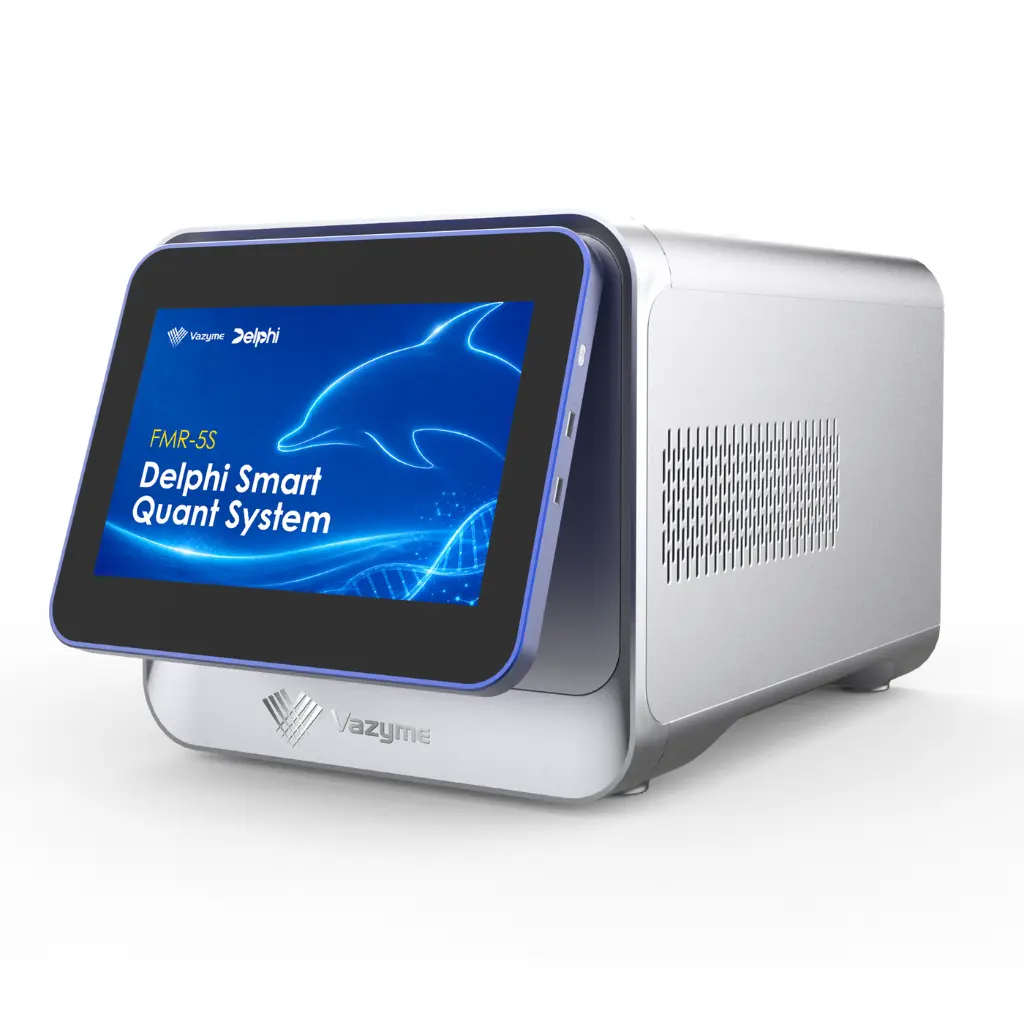
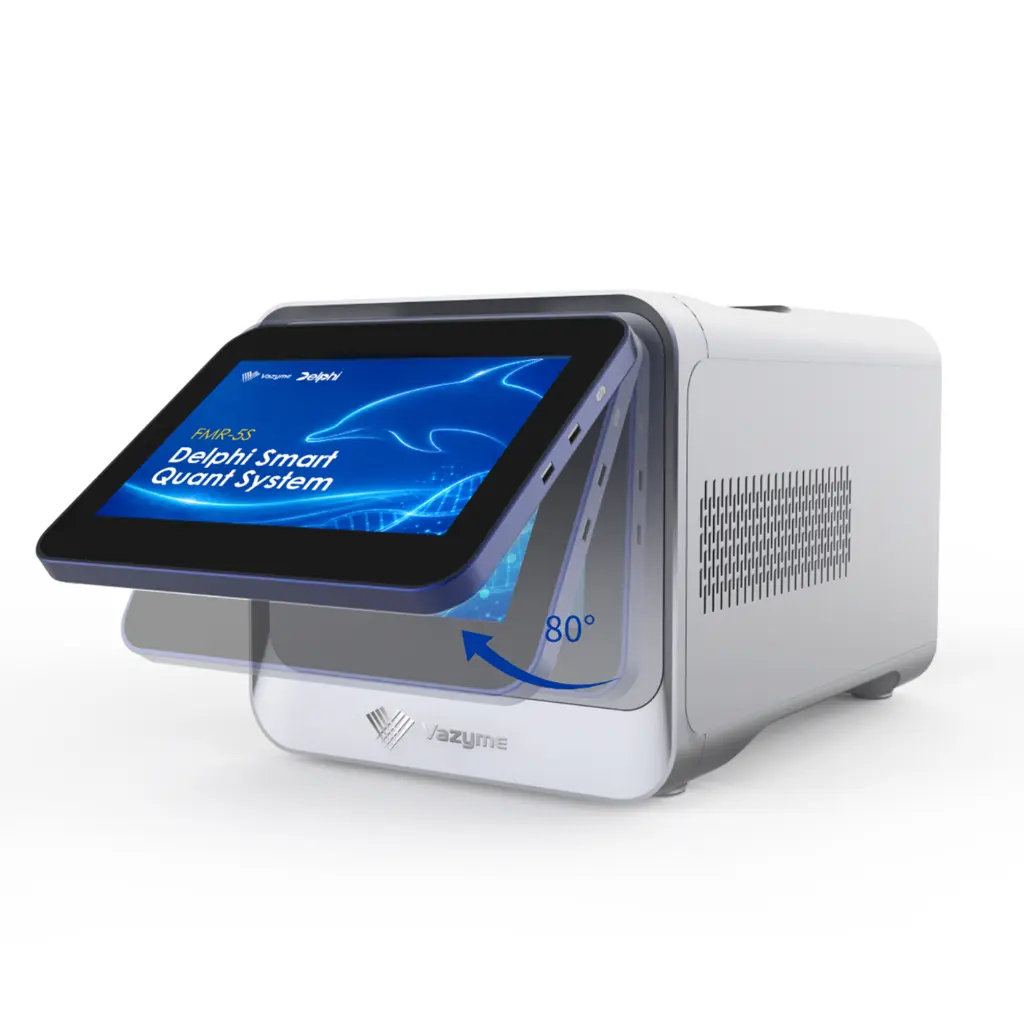

Delphi Smart Quant System
FMR-5S
The Delphi Smart Quant System combines a large touchscreen (Screen), smart gradient optimization (Smart), ultra-fast detection (Speed), high sensitivity (Sensitivity), and long-term stability (Stability) to deliver a faster, smarter, and more reliable qPCR experience. With 5-second full-plate detection, a 12.1" HD display, and automation-ready features, FMR-5S is built to accelerate your research with confidence.
It supports a wide range of analysis modes, including absolute and relative quantification, genotyping, positive/negative calls, melt curve analysis, protein thermal shift assays, high-resolution melting (HRM), and multicolor melting curve analysis (MMCA), making it a versatile tool for diverse research applications.
Features
S-Class Real-time PCR instrument

Screen
A 12.1" HD touchscreen makes setup and monitoring easy, clear, and intuitive.
Smart
With 12-column temperature gradients, condition optimization happens in a single run.
Speed
From 8°C/s ramp rates to 5-second full-plate detection, speed is built into every step.
Stability
LED-based optics, no need maintenance, long lifespan. With auto-tray and multi-instrument control, it fits right into automated workflows.
Sensitivity
Strong signals, ultra-low background—get confident results, even from low-abundance targets.
Key Software Functions
- Flexible PCR and fluorescence detection parameter settings
- Intuitive editing of thermal cycling programs and sample information
- Real-time monitoring of amplification and instrument performance
- Comprehensive data analysis:
- absolute and relative quantification
- genotyping
- positive/negative calls
- melt curve analysis
- protein thermal shift assays
- high-resolution melting (HRM)
- multicolor melting curve analysis (MMCA
- Easy data export in multiple formats
- Support for direct result printing
- Remote firmware upgrade capability
- Built-in fault protection & alarm system
Specifications
Application
The real-time PCR technology (as exemplified by Vazyme’s solutions) enables fast and precise analysis across diverse life science fields. It supports various methods for gene expression, genetic variation, and molecular detection in mono- or multicolor mode.
The applications span:
Basic Research
Food Safety Testing
Translational Medicine
Aquaculture & Poultry Testing
Genetic & Prenatal Testing
Environmental Monitoring
Plant & Animal Breeding
Primary applications include gene expression analysis, miRNA profiling, mutation analysis, CRISPR validation, GMO detection, pathogen testing, adulteration identification, biomarker discovery, drug response analysis, ctDNA/exosome analysis, rapid pathogen screening in aquaculture/poultry, CNV analysis, NIPT, microbial/viral testing in water/soil/air, marker-assisted selection, trait genotyping, and variety ID. These solutions are designed for life science research and related applied fields, supporting both basic and translational scientific endeavors.
Frequently Asked Questions
Module-based control monitors the temperature of the heating block;Tube-based control monitors the actual temperature of the reaction liquid inside the tube.
For example, when the set temperature is 95 °C: Module-based control: Timing starts once the block temperature reaches 95 °C. Tube-based control: Timing starts only when the liquid inside the tube actually reaches 95 °C.
Regardless of how many wells you have, you must choose a control method. Of course, you can also set a default method in the tool.
Yes,we provide a mouse in the packing box.
Column
Simply ensure the correct experiment type is selected, the experiment protocol is set up correctly, and the fluorescence channels are activated properly. Other options can be configured after the experiment concludes.
Theoretically, it is possible. This instrument essentially functions as a computer with a built-in Windows system. However,I need to double-check with the engineer.
Most common printers on the market can be connected.
Yes, the whole plate's signals will be detected. After the experiment, you can use the plate setting to configure which wells to display.
Marlow Customized Peltier Modules refer to the customized thermoelectric cooling modules produced by Marlow Industries, USA. These modules are primarily used in high-precision temperature control scenarios such as medical equipment and PCR instruments. Based on the Peltier effect, these modules achieve solid-state cooling/heating through semiconductor materials, supporting precise temperature control.
Our genotyping is dependent on the fluorescence amplification extent. Currently, there is no detection limit on the instrument, but with the reagent, there is.
